LONG TIME GONE

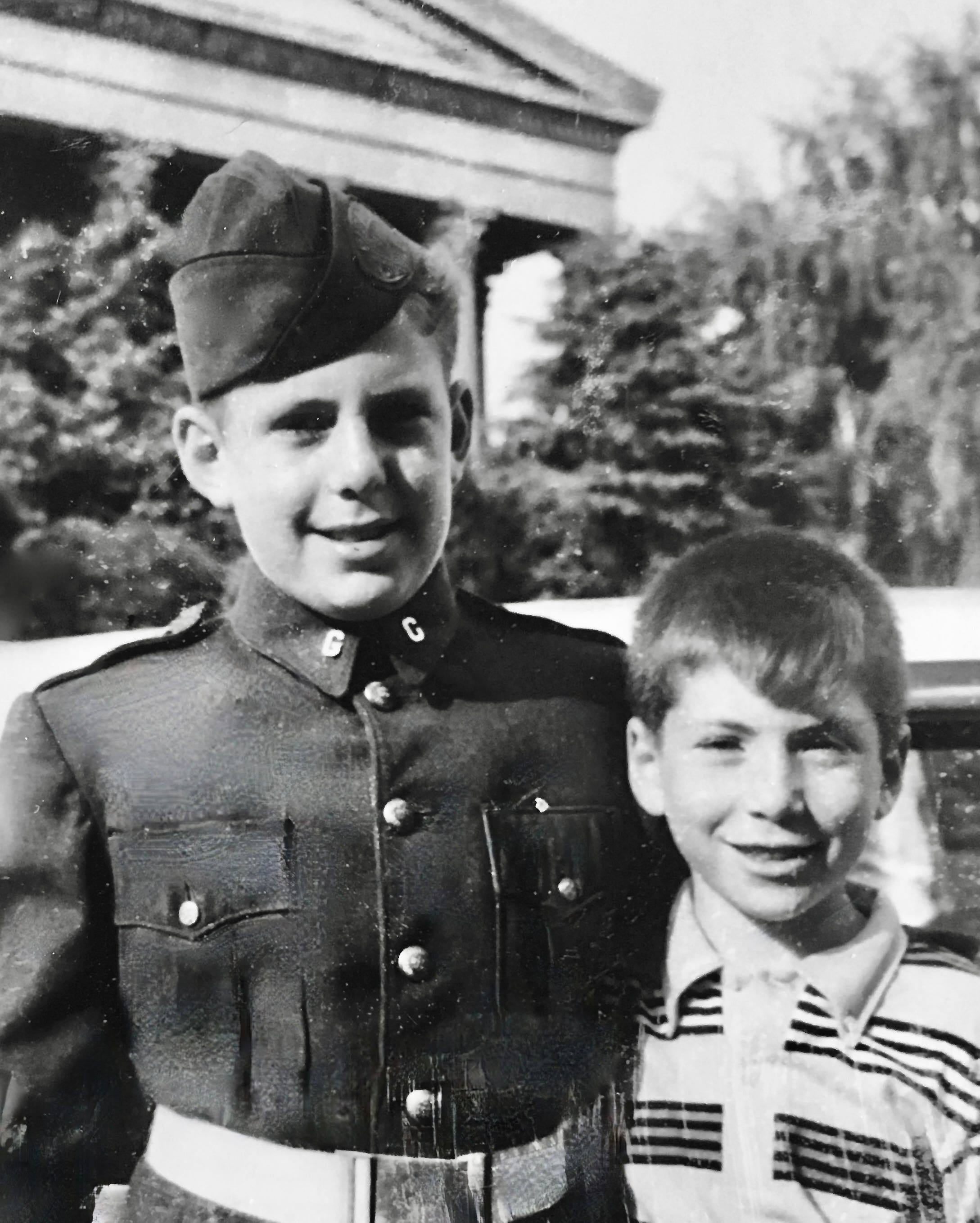
My baby brother was 12 and I was 15 when our grandfather died. He was 75. As we were carrying his casket to the hearse, tears running down our cheeks, my baby brother whispered to me, “If your last name was Bearer, what would you name your first born son?” We did not exactly drop grandpop, but we struggled to hold up our end of the bargain through the laughter. Fortunately, our uncles were big and strong.
My baby brother is 75 years old today. Although we live on distant coasts, we still laugh a lot and cry a little, and know how lucky we are to have had each other for nearly eight decades, someone to call whenever you can’t remember the opening act for Patti Smith at the Bijou or the name of Cousin Eric’s dog. (It was Nikita; Aunt Freda and Uncle Herman were fellow travelers and fans of Khrushchev.)
Brother Lee and I tend to agree on politics, disagree on films, and debate most everything else. The current issue of contention is which song brought us to tears and forced us off the Atlantic City Expressway at three in the morning in the summer of 1969 on our way to Philadelphia to secure an FCC license to start an underground radio show on WLDB-AM.
Brother Lee contends that it was “For What It’s Worth.” I think it was “Long Time Gone.” I can understand his confusion-- Stephen Stills was in both groups and Buffalo Springfield was the most influential American group of the 20th century, playing in or paving the way for CS&N, Neil Young, Crazy Horse, CSN&Y, Poco, Loggins and Messina, Super Session (Side2), the Souther/Hillman/Furay Band, Manassas, Flying Burrito Brothers, the Eagles, Wilco, and, dare we say, a healthy portion of today’s “country” groups.
For what it’s worth, “For What It’s Worth” remains a timeless protest anthem, filled with paranoia and agitprop, but it never hit the deep emotional chords of “Long Time Gone,” never evoked the sadness and loss that could bring me to tears right now. (Be right back.)
It should be noted that there is no familial disagreement that the night in question started at Club Harlem, the most integrated spot in a most segregated city. The crowd was black and white, straight and crooked, lushes and lookers, criminals and cowards and Marvin Gaye was singing in the adjacent room, giving new meaning to “Ain’t That Peculiar.” In the main room, in the hole of a huge horseshoe bar, Crazy Chris Columbo was leading the band’s nightly rendition of “You Can’t Sit Down.” (Later made famous by Len Barry and The Dovells.)
With nary a spoken word, we were offered a joint at the bar. $20. Expensive. The dealer promised, as dealers were wont to do, that it would be the best dope we’d ever smoked, and would surely get us through the long night ahead. Holding a solitary spliff of Panama Red, he said, was much safer than a lid. In moments such as these, I relied on the expertise of my baby brother, him being a pot dealer himself since tenth grade and brandishing a rather impressive record: zero arrests and only two run-ins with guns; one stuck into his ribs and one in his face, respectively, if not respectfully. Shaken not stirred, he carried on, firmly believing in the healing power of weed and the well-heeled lifestyle it provided. Baby bro knows primo.
The first time I had heard about his affection for marijuana, four years earlier, I was furious, and then curious. Not wanting to come off like a square parent, I told him I would try the stuff before condemning it and beating him silly. So I smoked a modest joint. On the turntable was “It’s Alright, Ma.” When the song concluded, I asked my baby brother if family members could get a discount on his product. We laughed and were off to the races. Hair grew longer, bell bottoms wider, consciousness deeper, or higher, your call. We were shootin’ for the moon.
Why we were in Atlantic City was to celebrate the grand opening of a mutual friend’s head shop—leather belts and cowboy boots and jackets with fringe, as well as pipes, papers and hookahs. She also had a luxurious hashish stash. We were stardust, we were golden, we had chosen Yasgur’s farm over the killing fields of Cambodia, and we knew Nixon was the most psychotic president we would ever see, and we knew that all you needed was love, love, love, some good dope, and the right music. We turned on the radio in search of something psychedelic. No such sounds ushered forth, so I, high, casually said, “We could do better than these local yokels.”
Light bulb moment.
The next day, my brother and I visited a series of radio stations in Atlantic City and told them if they wanted some younger listeners, they needed some younger disc jockeys to spin some younger music. One station, WLDB-AM, a struggling all-Christian station, went off the air at midnight because their listeners were parishioners of an early-to-bed-early-to-rise congregation. Management wanted $35 for every hour after midnight. Calculator in hand, we figured it would cost $210 to broadcast until dawn. Or $1,470 a week. So we traipsed up and down the boardwalk trying to sell commercials to souvenir stands, dance clubs, salt water taffy joints, sub shops, ice cream parlors, Planters Peanuts, Steel Pier, and our friend’s new head shop. Then we scoured Ocean City and Wildwood and when we sold enough to get started, writing and producing all the spots ourselves, we were ready to launch The Midnight Express on WLDB-AM. To man the mic, I needed an FCC radio license.
Thus the drive to Philly. The test was a breeze. We would return to Atlantic City the very next day to segue from Erik Satie to Blood Sweat & Tears, from Lenny Bruce to Malcolm X. News headlines were punctuated by appropriately inappropriate songs by Cream or Billie Holiday or Captain Beefheart. Radio Free Boardwalk, baby. That I eventually got busted on the air by a couple undercover narcs posing as fans is another story for another time. Right now, we are driving to Philly to get that radio license.
The dope was as good as promised. We were as high as zeppelins, singing along with The Moody Blues and The Doors until the song came on, the new song, and it halted the hilarity. We were engulfed by a sombre spirit—a heavy heartbeat of a bass line was backed up by a haunting organ. Then piercing guitar licks introduced David Crosby’s ethereal tenor. It’s been a long time comin’…it’s goin’ to be a long time gone…and then the sweetest CS&N harmony…And it appears to be a long…appears to be a long…appears to be a long time…Crosby responds: Yes, a long, long, long, long time before the dawn.
What the lyrics were about or where they were going was incidental-- the tone and texture were enough. Mystery and lamentation. A dirge with defiance. Turn, turn any corner…hear, you must hear what the people say…you know that something’s going on around here…it surely, surely, surely won’t stand the light of day…then that sweet harmony again.
Crosby went from snarl to sotte voce to snarl again, exasperation to elegy, mourning for someone, for everyone, and none too happy about any of it. Many years later I learned that Crosby had written “Long Time Gone” on the night Bobby Kennedy was shot in the head, twice. He didn’t know how to deal with the assassination of another Kennedy brother until the first lines hit him: “Speak out, you got to speak out against the madness…you got to speak your mind if you dare…but don’t, no, don’t try to get yourself elected…if you do you had better cut your hair, mmm…”
And then he was up all night with drugs and despair. Somehow, all his emotions seeped into the plaintive song with no mention of the murder. The composing, and the long, long night, finished as the sun rose. “But you know the darkest hour is always, always just before the dawn.” Though scientifically inaccurate, the metaphor is a good on and a song of such anguish needed a faint flicker of hope before any rest.
When “Long Time Gone” concluded with a couple slurring discordant bars, Brother Lee and I were bawling breathlessly and had to pull off the road. Out of the car, we immediately hugged, embracing the terror and the transcendence, the chaos of the struggle, and the glorious absurdities of the universe; three hippies on a used, bruised sofa sing a four-minute song in Laurel Canyon that somehow emanates from a VW dashboard in the middle of the Garden State and two brothers from the City of Brotherly Love dressed in ironic Army/Navy gear go walkin’ on the moon, never higher, never closer, grieving for America, grieving for their youth, grieving for the father who died suddenly when baby Lee was three weeks old and his big brother was three years.
In the end, of course, which song doesn’t really matter. Maybe brothers have engaged in such debates since the first birds sang in the first garden. If my brother still thinks it was “For What It’s Worth,” he’ll have to write his own essay. He can do that; he recently published a memoir called “High,” even though the book celebrates decades of sobriety and drug counseling. What really matters is how long and how tightly we clung to each other, blind to the idea that we would remember (and disremember) that night more than a half century later, a night where nothing really happened except we smoked a joint and heard a song and loved each other so deeply and so completely that we still believe the darkest hour is always, always just before the dawn.
Happy birthday, bro. Long may you run
.
What a wonderful birthday greeting‼️
Ahhhhhh….. those were the days